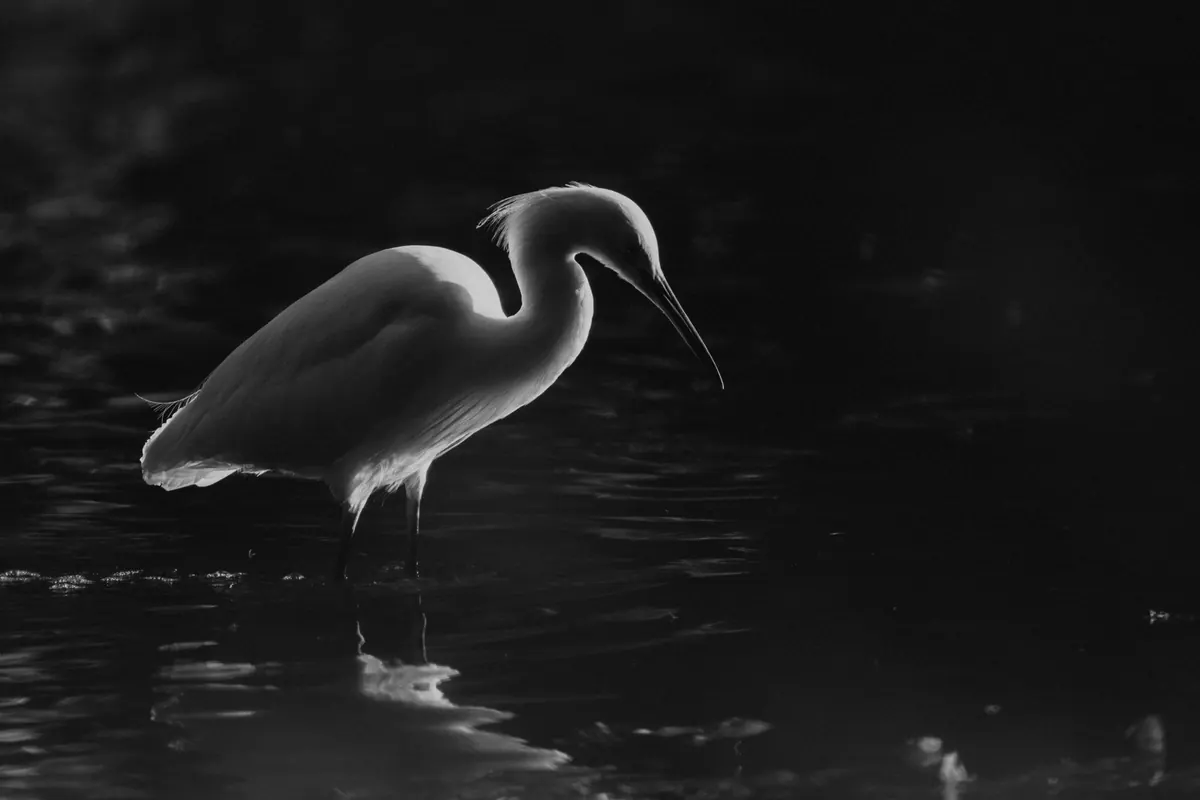
A hunched grey shape on the far bank. A slim white bird picking its way through the shallows twenty metres closer. Both are long-legged, long-necked fish-eaters, and both can turn up on the same estuary, canal, river or flooded field. Not long ago the identification was straightforward, because little egrets were genuinely scarce here. They are not scarce now. As the white birds have spread inland and north, working out which one you are watching has become one of the most common puzzles in British birding.
Most people begin with colour, and most of the time that works, because only one of the two is grey. Trouble arrives when a heron looks washed-out in bright light, or when a white bird is seen in silhouette and scale is hard to judge.
Grey herons are big. An adult stands roughly a metre tall, with a thick neck usually folded into a loose S and shoulders that look heavy and rounded. The head is substantial, and the bill is a long yellow dagger. Little egrets are noticeably smaller, slim, upright and neat, with a fine black bill and a neck that looks longer and thinner in proportion to the body.
The quickest field fix is to compare your bird with something else in the frame. A little egret feeding beside a mallard is clearly taller than the duck, but a grey heron makes both look small. If there is nothing to compare against, try to judge the bird against the vegetation it is standing in. Reeds are a decent ruler once you have seen a few birds next to them.
Adult grey herons show a grey back and wings, a whitish head and neck, and a black stripe running from the eye to a drooping crest plume. There is a dark patch at the shoulder, and the bill is yellow. Legs are dull yellowish-brown. Young birds in their first year look greyer and scruffier, with a duller bill and no proper crest, which can make them look softer and paler than the adults you are used to.
Little egrets are entirely white at every age. The bill is black, the legs are black, and the feet are bright yellow. That last detail is the one worth memorising. In breeding plumage, two long, fine plumes trail from the nape, and a shaggy cluster of plumes sits on the back.
Grey herons are ambush hunters. A typical bird stands motionless for minutes at a time, neck folded, apparently doing nothing, then throws its head forward and comes up with a fish, a frog or a small mammal. Feeding birds are usually alone and often wary of people. They nest colonially, though, and a heronry in tall trees can hold dozens of noisy pairs.
Little egrets are busier. They walk with purpose, run a few steps, shuffle their feet through the mud to stir up prey, lunge, and sometimes flick their wings or spin on the spot. They often feed in loose groups and roost communally in trees, and those roosts can contain grey herons, cattle egrets and other white herons. A still, patient bird is more likely to be a heron. A twitchy one is more likely to be an egret.
Both species fly with the neck folded back into the shoulders, which is the important thing to remember. Cranes, storks and spoonbills fly with the neck stretched out in front, so a white bird flying with an extended neck is something else entirely.
Grey herons flap slowly on broad wings and look heavy and deliberate, with the legs trailing just behind the tail. Little egrets have quicker, lighter wingbeats and, usefully, their yellow feet project past the tip of the tail in flight. On a good view that small yellow flash settles the identification on its own.
Voices are worth learning too. A grey heron flushed from a pool often gives a harsh, grating croak, a sound that carries and is hard to mistake once you know it. Little egrets are more vocal around colonies and roosts, with a repeated rasping croak that sounds rougher and more clipped than the heron's call.
Grey herons are resident throughout the UK and are found practically anywhere with water and fish: garden ponds, canals, reservoirs, saltmarsh, wet fields and rocky coast. They nest early, sometimes from January, which is why you may see adults carrying sticks to a treetop while the weather is still grim.
Little egrets are the newcomers. They colonised Britain and Ireland in the late twentieth century and have since spread widely around the coast and well inland along rivers and wetlands. Numbers build in autumn and winter, when birds gather at communal roosts and spread onto estuaries and flooded fields. In some inland counties they remain genuinely scarce, so a white heron far from the coast deserves attention. Cold snaps can also push birds around, which is worth remembering when you find one on a frozen morning.
Two more species complicate matters, and both are now regular enough to take seriously. Great white egrets are almost grey heron-sized, with a very long kinked neck, a yellow bill and dark legs and feet; their feet do not project beyond the tail in flight. Cattle egrets are small and stocky, with a short, stout yellow bill and a hunched look, and they often feed in fields among livestock rather than in water.
Spoonbills are white and heron-like but fly with the neck extended and carry an unmistakable spatulate bill. Snowy egrets, rare vagrants here, also show yellow feet but differ in bill and face pattern. If you find something that does not fit, take notes and photographs rather than forcing it into a box.
Next time you find a long-legged bird and the answer is not obvious, work through the same short sequence. It takes less than a minute once it becomes habit.
Grey herons and little egrets now share much of the same water, and seeing them side by side is the fastest lesson available. Give the bird time, trust shape and behaviour over a single glance, and the identification will stop being a puzzle and start being a pleasure.
Photo: Matheus Bertelli / Pexels
A practical, ethics-first guide to ten UK wetlands where grey herons, little egrets and bitterns can be watched...

A practical, standardised checklist for recording heron behaviour — from foraging strikes to dusk roost counts — so...
Restored wetlands across the UK reveal what long-term heron counts can show — where conservation is working, where...

Exploring herons, wetlands, and wild science..
