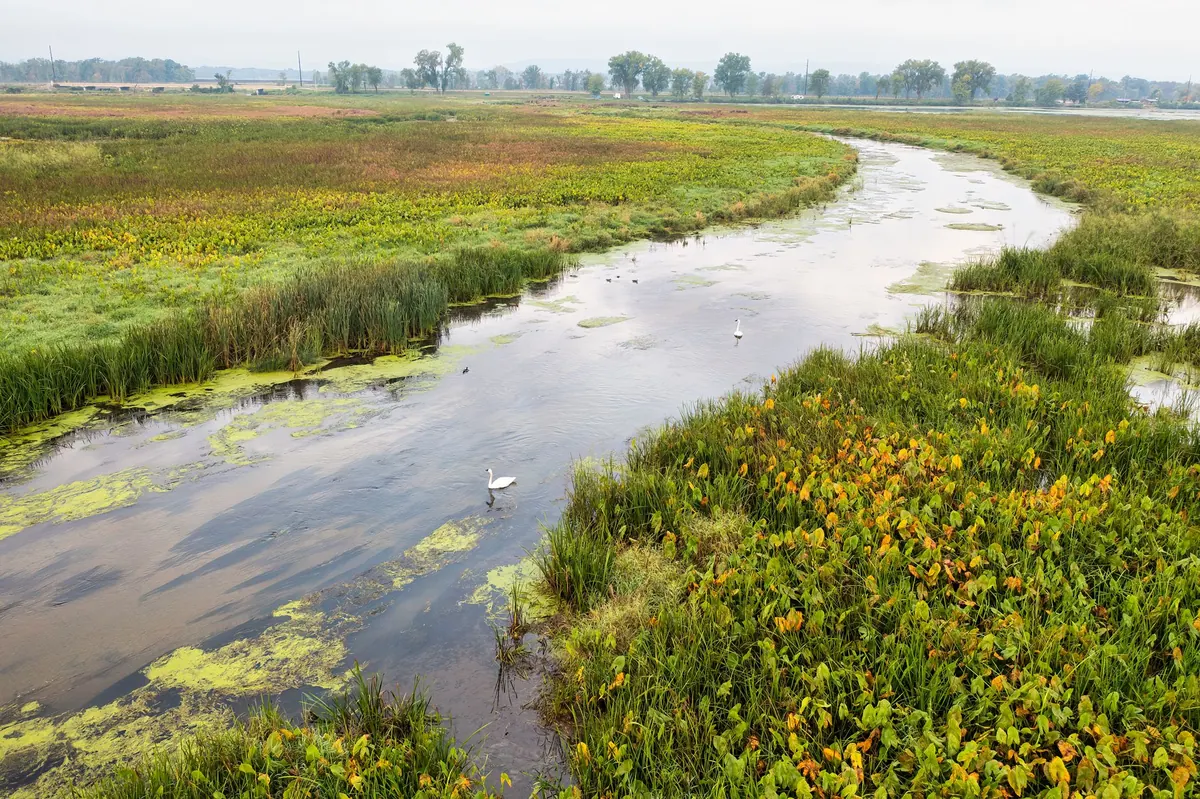
Grey herons are easy to overlook. They stand in the shallows looking faintly put out, then lift away on those slow, unhurried wings. That familiarity hides something useful. Herons sit near the top of the wetland food web, and they nest in colonies that can be counted from a distance without disturbing them. Britain has been doing exactly that for close to a century, and the record gives a remarkably honest verdict on whether our restored wetlands are actually working.
A heronry is a working summary of a wetland. To raise chicks, herons need shallow water holding fish, amphibians and large invertebrates, plus nesting trees and enough quiet to sit tight through a cold March. When one of those fails — a dry spring, a fish kill, a new path routed too close to the canopy — the birds tend to respond before the vegetation does. Herons are also convenient subjects: colonial, site-faithful, and big enough to count with binoculars from a gate.
The caveat matters as much as the method. Herons are mobile and adaptable. A colony that shrinks may have shifted a few miles rather than declined, and a new nest cluster may simply be a satellite of an older one. Heronries move when trees blow down, when woods are felled, or when disturbance pushes birds deeper into cover. So a nest count is a clue, not a verdict. You need the context: water levels, fish populations, weather, disturbance, and what neighbouring colonies are doing. That is why the long-running Heronries Census matters. It does not just count herons; it counts them in the same places, at the same time of year, across generations.
The British Trust for Ornithology’s Heronries Census began in 1928, making it one of the longest-running breeding bird surveys in the world. It has survived cold winters, agricultural intensification, river engineering, and the draining and re-flooding of entire landscapes. The record shows that grey herons are resilient but not invulnerable. Numbers fell after severe winters such as 1962–63, when frozen water locked birds out of feeding areas, then recovered as wetlands thawed and fish stocks rebounded. In the later twentieth century, the overall trend was upward in many regions, though not everywhere. Some heronries disappeared as floodplains were drained, rivers were straightened, and mature nesting trees were lost. Others appeared or expanded where gravel pits, reservoirs, and restored marshes began to hold water and fish again.
That mix of loss and recovery is exactly what makes heron data useful for conservation. It does not tell a simple story of decline. It tells a story of local decisions. Where people put water back on the land, herons often notice before the official monitoring report is written.
The most encouraging UK examples are not pristine wildernesses. They are working landscapes that were drained, dug up, polluted, or built over, then deliberately rewetted.
These are not isolated victories. They are demonstrations. A heronry on a restored site says that the food web is working at least well enough to raise young. It says that water is present long enough, shallow enough, and clean enough. It says that disturbance is low enough for birds to sit on nests. Those are basic wetland functions, and they are precisely what many degraded sites lack.
It is tempting to treat herons as a single measure of wetland health. They are better understood as a leading indicator.
“A heronry is not a biodiversity audit. It is a smoke alarm: crude, hard to ignore, and useful precisely because it goes off when the basics are missing.”
If you want to use herons as a practical gauge, the method is simple but disciplined.
The lesson from heron data is not that we should manage wetlands only for herons. It is that the things herons need are the same things many wetlands need: water held on the land for longer, shallow edges, healthy fish and amphibian populations, mature trees, and freedom from constant disturbance. Restoration that delivers those basics tends to deliver more than herons. It can bring back bitterns, otters, water voles, dragonflies, and the less glamorous invertebrates that make a wetland function.
There is also a warning in the success. Many restored sites are small and isolated. A heronry can persist for years in a modest reserve, but the wider landscape still matters. Droughts, water abstraction, pollution, invasive species, and development pressure can undo local gains. Herons are mobile enough to move on; specialist species may not be. That is why the best wetland conservation works at a catchment scale, reconnecting floodplains, protecting nesting trees, and keeping water in the ground.
So the next time a grey heron stands in the shallows looking faintly put out, consider it a data point. It is not just a familiar bird. It is a witness to whether the water is still there, whether the fish are still there, and whether we have made room for wildness to raise its young. In a country that has lost so many wetlands, that is a success story worth counting — and repeating.
Photo: Tom Fisk / Pexels
A practical, ethics-first guide to ten UK wetlands where grey herons, little egrets and bitterns can be watched...

A practical, standardised checklist for recording heron behaviour — from foraging strikes to dusk roost counts — so...
Both herons and rooks nest in noisy tree colonies, but the clues are easy to read once you know what to look for....

Exploring herons, wetlands, and wild science..
