A stand of tall trees, a dozen untidy stick nests high in the crown, and a chorus of harsh calls drifting across a winter field. That is either a heronry or a rookery, and from a distance the two can look remarkably alike. Get closer, and they separate quickly — in the trees the birds choose, the shape of the nests, the timing of the season, and the noise coming out of the canopy.
Here is a working checklist for UK birds, assuming you are looking at a tree colony from a path or field edge with no clear view of the birds themselves.
Grey herons usually nest in tall, mature trees close to water — rivers, lakes, reservoirs, canals, fish farms, old estate ponds. Scots pine, oak, beech, sycamore and ash all get used, and a heronry will often sit in the same copse for decades. Nests are built on strong horizontal branches, sometimes high in the crown and sometimes surprisingly low and exposed, with anything from a handful of pairs to several dozen.
Rooks are farmland and village birds. Their rookeries tend to sit in tall deciduous trees — ash, sycamore, oak, beech, horse chestnut — often in a small copse, churchyard, avenue or shelterbelt surrounded by fields. Rookeries are frequently larger and tighter than heronries, with many nests packed into the tops of just a few trees.
One caution: little egrets and cormorants now nest in some British heronries, so a mixed colony with whitewash streaking the trunks deserves a second look.
Heron nests are platforms. Think bulky, flat-topped piles of sticks, often around a metre across, with the odd large stick jutting out at an angle. From underneath they look chaotic, as if a gale should have finished them off years ago. Smaller twigs are woven in on top, sometimes with fresh green material added.
Rook nests are cups. They start with a thick base of sticks and are then plastered inside with soil, roots and grass, which gives them a dark, heavy, solid appearance — quite unlike a heron's pale tangle. The soil is the giveaway. Look for dark clods, earthy linings, and a litter of sticks and earth on the ground beneath the trees.
Grey herons are among the earliest large birds to nest in Britain. They return to traditional sites in midwinter, pairing up and rebuilding nests in January, with eggs from February onwards and young in the nest through spring. By the time most trees are in leaf, heron chicks are often well grown.
Rooks are early too, but usually a step behind. Rookeries begin to fill in late February and March, with most laying from mid-March into April. A colony in full swing in late March, birds constantly flying in carrying soil, is almost certainly rooks.
The February overlap can be confusing, so treat timing as a supporting clue rather than a verdict.
Sound often settles the question before you see anything at all.
Rooks are relentlessly vocal at the nest. The classic rookery sound is a rolling chorus of harsh kaah calls, with birds arguing, jostling and greeting one another constantly. Chicks beg with a loud, rasping, almost frantic note.
Grey herons are quieter, but their call is unmistakable: a grating fraaank or kraaank, often given in flight and not unlike a rusty gate. At the nest you will hear croaking, bill clattering and the rasping calls of well-grown young — a rougher, more sporadic racket than the steady cawing of a rookery.
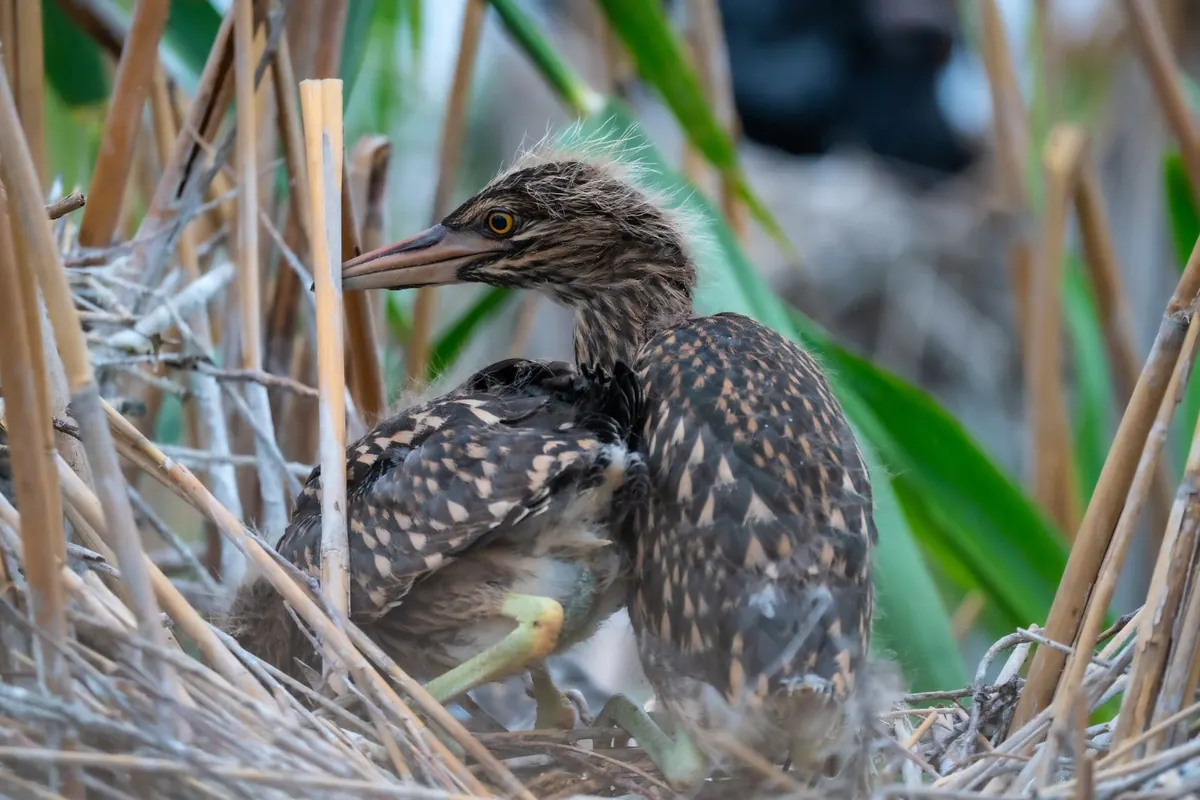
If you can see the birds themselves, identification is straightforward.
Photo: Saleh Bakhshiyev / Pexels
A practical, ethics-first guide to ten UK wetlands where grey herons, little egrets and bitterns can be watched...

A practical, standardised checklist for recording heron behaviour — from foraging strikes to dusk roost counts — so...
Restored wetlands across the UK reveal what long-term heron counts can show — where conservation is working, where...

Exploring herons, wetlands, and wild science..
